Today on Instagram and Facebook, Julia Quinn announced the launch of JQ Editions, a historical romance special edition subscription service.
Per her announcement, the special editions will include “luxurious soft-touch covers, illustrated endpapers, and fabulous sprayed edges.”
(SPREDGES?! Everybody drink!)
Quinn will be selecting each title, and says in the introduction that some will be “brand new,” while others will be “recent gems, or classics of the modern genre.”
Per the caption, “Each and every title is hand-picked by Julia Quinn, and she works personally with illustrators to make sure that the art reflects the story and honors the author.”
I am fascinated by this announcement on several levels because it’s the full-speed collision of several major trends. There’s the Kickstarter part, the historical romance part, the special edition part – my brain is Jiffy Popping all over the place.
Let’s start with the Kickstarter of it all. Every year for the podcast Patreon, Amanda and I do predictions for the coming year, and another episode where we listen to our older predictions from the previous year to find out how accurate we were.
One of my predictions for 2026 was the continued rise of Kickstarter as as a major option for authors who are frustrated by the diminishing returns when self publishing, particularly as a platform exclusive, and by the diminishing returns of working with a publisher when shelf space continues to shrink and mass market, the format most associated with historical romance, died this year. When a publisher like Harlequin can’t meet the demand for paperbacks of Heated Rivalry, one of the greatest romance television adaptations of all time, and in the same year,“After the End,” an author collective Kickstarter, crossed $1.4 million in sales, it’s not difficult to understand the increasing appeal of Kickstarter.
Oriana Leckert, who is the Head of Publishing at Kickstarter, said during our interview,
…I think two, two really, really key things that make Kickstarter very special for authors is that our cut is five percent.
Sarah: Yep.
Oriana: Five percent. Also we have Stripe, who processes our payments; they take three to four percent. Even so, you’re paying less than ten percent in fees, which is so much less than you’re paying to any other avenue through which you might sell your books
Another benefit to Kickstarter that I still think about: data. As Leckert explained it,
Kickstarter is in the business of giving you your audience…. [A]s we see the continued fracturing and dissolution of social platforms, as we watch these, like, you know, mercurial to malevolent executives with a flick of the wrist change their algorithm in a way that now that, like, you know, a hundred thousand strong audience that you’ve worked so hard for, you can no longer access, or not as effectively.
…If you run a Kickstarter campaign, first of all, during the campaign you get a tremendous amount of data about where your backers are, where they’re coming from, are they using desktop or mobile? What time of day are they backing? Which of your promotional avenues have reached them? And then afterward you get everybody’s email addresses! You get to send them surveys. You get to ask them all sorts of questions….
[H]olding onto those direct avenues to reach your readers is so much more important than ever. This is something that we can do for our authors that Amazon’s not going to give you.
Kickstarter is also an excellent way to test new ideas, as Katee Robert explained: “I’m going to be circling back to Kickstarter a lot in the future, just because it’s a very interesting platform and, and if it doesn’t fund, it doesn’t fund, and then you do something else.”
So that’s the Kickstarter part. But as I said, a subscription box of historical romance special editions is also dead center of an intersection of other major trends: special editions (obvs), Rrrrrrrromantasy market saturation, and the future of historical romance.
I’ve said many, many times, per the Bruce Springsteen Law of Publishing, “everything dies, baby, that’s a fact. But maybe everything that dies, someday comes back.” In other words, no genre ever dies. They come back in a different form. Like Pokémon. Just like how New Adult was Chick Lit re-invented for readers coming of age in a terrible economy instead of a good one, or how romantic suspense with military and law enforcement heroes, which used to be everywhere, seem to have given way to a mafia and unaffiliated special ops heroes. No genre dies, but it will evolve before it comes back.
The historical romance genre is not in terrific shape in terms of market strength, to put it mildly. But it’s not dead — the mass market paperback is dead, but not historical romance, even though it was most published in that trim size and at that price.
So how might the JQ Editions affect the state of historical romance? Could historical special editions reinvigorate the historical romance audience? Or will the audience for historical special editions be found with established historical romance readers who have deep ties to the genre, and to specific books?
Both, possibly?
First, special editions are, as the memes say, so hot right now, and have been for a few years. Moreover, readers on social media who are likely to be part of the special edition audience have been ‘rediscovering’ historical romances because the internal conflicts coupled with the external class structure produce a lot of yearning and pining. The new trend of “Who put all this pining in historical romance?” reader engagement only helps a project like JQ Editions. The same readers who adore special editions of much loved Rrrrrrrromantasy titles may also seek out special editions of historical romances that are still popular.
The thing about special editions, though: they’re more aesthetic than practical. No one is going to sit down with a special edition book with end papers, art, and spredges (drink!), and start reading while eating cheeze puffs. Cheeto dust + special edition = rage bait.
A special edition isn’t necessarily a reliable discovery mechanism, either: the goal of a special edition is to reach fans of the book with a unique artifact of that book’s popularity and virality. Which leads me back to audience.
The audience for a historical romance special edition would have to include historical romance readers, obviously. Many historical romance fans are collectors of romance as well – specific cover artists, models, or entire backlists for beloved authors. Historical romance is a older genre with books that have been favorites for literal decades. Some readers may be very excited to have unique art editions of their fave, simply because the special edition trend finally includes them.
Attaching the artistic enhancements of a special edition to a book that has been a reader favorite for most of their adult lives? I hope Quinn picks some old favorites because if she’s picking books that have Big Reader History attached, the subscription Kickstarter could do very, very well. I’ll bet folding money, as my sister says, that there will be loud and ample calls for Kleypas editions, particularly Devil in Winter.
This may be a fusspot feature of my age and perspective, but personally, I want less stuff in my house, not more. So I haven’t been in the audience for special editions, and everything I say must be taken with a Volkswagen-sized grain of salt here. But even though I am pretty selective about stuff resides in my home, I am so, so curious to see which books are selected, and what they’ll look like, and how they’ll be decorated and styled. (Lol – that’s like a whole new job category, right: “book stylist.”)
Special editions are fandom artifacts, gorgeous representations of a specific book’s popularity at a moment in time. They also assign more visual cues to a three-dimensional book than mere cover and copy: the art and motifs on the cover or the spredges (drink!) visually communicates so much more about the story. And they’re usually gorgeous! Luscious paper, textured cover treatments, art and designs in lavish colors you can see from across the room – they’re meant to appeal to our senses and our experience with that particular story. Special edition treatment for historical romance could potentially aid in the evolution of the historical romance genre, especially if the titles included mix enduring favorites with titles that are part of historical romance’s evolution in progress.
A special edition has more opportunity to signal to a reader what’s inside, and it’s usually aimed at a reader who already knows that what’s inside is special to them. I am extremely curious to see what titles are included, and what they’ll look like.
What about you? Would you be interested in special editions of historical romances? Which one?! Are you interested in JQ Editions?
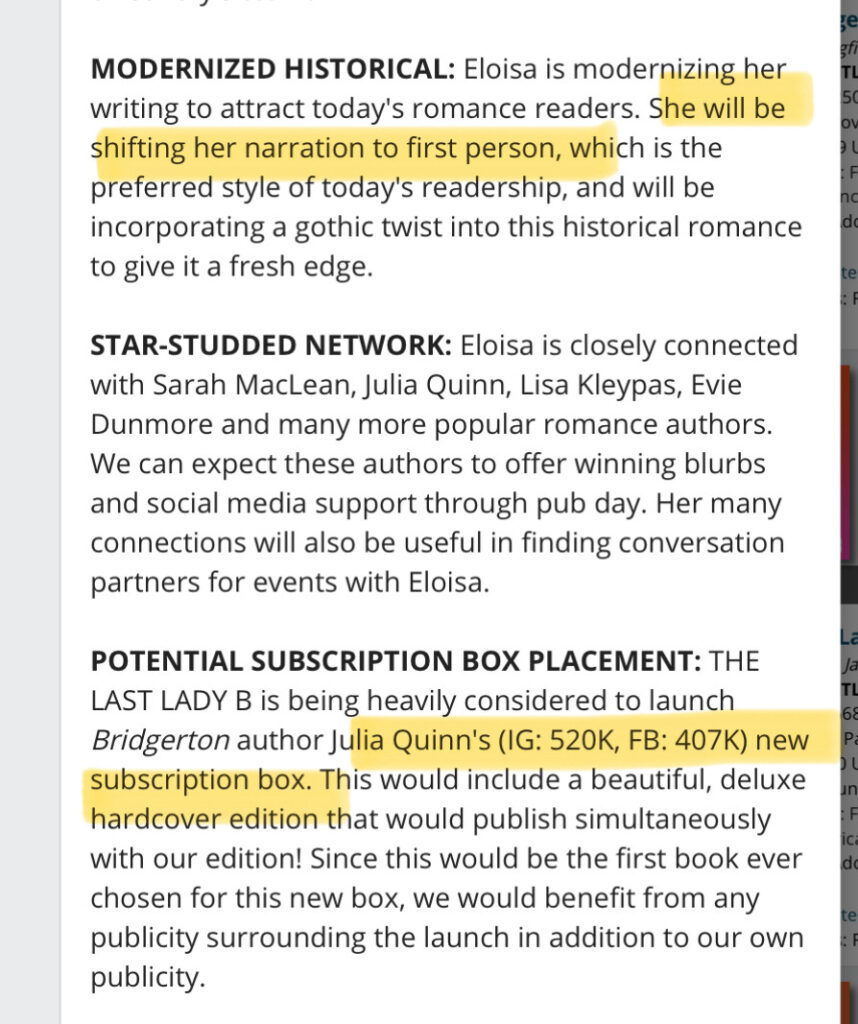
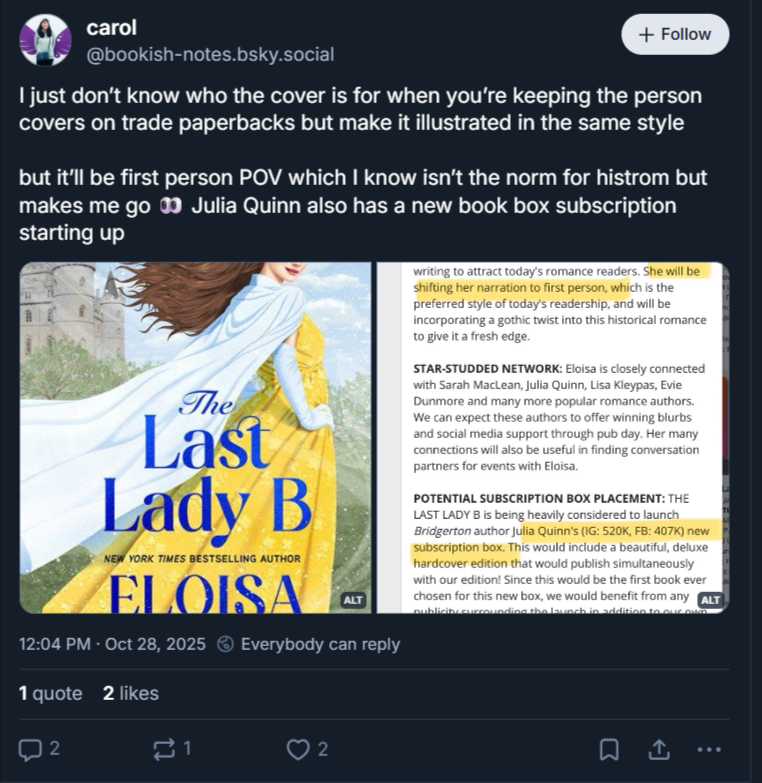
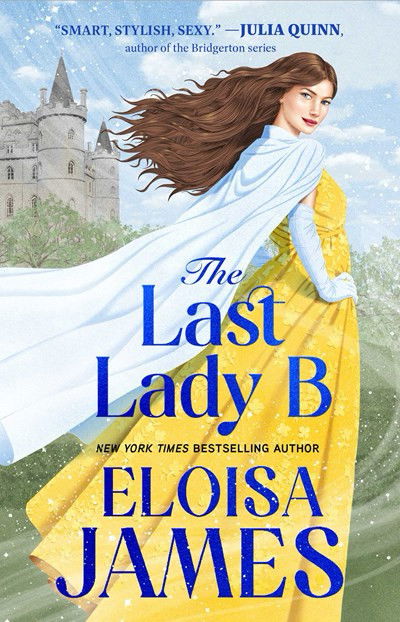
Bookish Notes shared a cover image and a screenshot of some marketing copy from the publisher about Eloisa James’ next book,The Last Lady B.
The marketing copy includes:
POTENTIAL SUBSCRIPTION BOX PLACEMENT: THE LAST LADY B is being heavily considered to launch Bridgerton author Julia Quinn’s (IG: 520K, FB: 407K) new subscription box. This would include a beautiful, deluxe hardcover edition that would publish simultaneously with our edition! Since this would be the first book ever chosen for this new box, we would benefit from any publicity surrounding the launch in addition to our own publicity.
The original post also notes that this is a historical romance in first person:
This is the cover, if you’re curious:
Launching with a new historical romance (in first person – that’s kind of a big deal) from a very popular author in a special edition would be an interesting strategy for the first box, and aims to capture some of the groups I mentioned above: fans of an author, fans of historical in general, and possibly potential new historical readers. I know many folks who make buying decisions based on hating first person pov, so I can only assume there are an equal or greater number of people who make buying decisions based on adoring first person pov.
Seriously, this remains so fascinating for me. It’s like a bunch of things I think about all the time colliding in front of me. Thanks for coming along for the ride.
Title: Earthquake Fandom: The Fantastic Journey Author: badly_knitted Characters: Fred, Scott, Travellers, Varian. Rating: PG Setting: An Act of Love. Summary: The travellers are trapped in a cave beneath a mountain, and Varian is missing. Word Count: 300 Content Notes: Nada. Written For: Challenge 501: Amnesty 83, using Challenge 62: Trapped. Disclaimer: I don’t own The Fantastic Journey, or the characters. They belong to their creators. A/N: Triple drabble.
It's gift card season and there are a couple sorts of books I would like to get with mine, but I don't even know what sorts of terms to start searching on.
1) Something about different legal systems and the philosophies that go with them. How they shape how people think about what the law is even for, and so forth. Would prefer to focus on modern systems, but historical examples are fine if they help illuminate the present. (E.g. I have come across mentions a few times that things work in such and such a way in France or its former colonies because they were shaped by the Napoleonic code.)
2) How the governments of really huge cities/metropoles work.
Blogs or newsletters are okay too. But no podcasts or YouTube series unless they're scripted, please.
+ I was going to do my yearly 5 icon slots as a gift to myself, and it turns out 550 is a hard limit and I can't have any more. No fair. I got DW money some other way but boo.
+ Fallout is apparently back! I watched both episodes yesterday and enjoyed them. We're getting more zany vault culture and I'm here for it. Also a delightful actor appearance, big plus there.
+ Absolutely fell behind on rec_cember. My brain has been Tired from being social every day. I do have a few more planned, fingers crossed they actually happen?
+ Christmas Eve was an absolute success. The food was lovely, everyone was healthy and in good spirits, and since there were no kids we took our time and opened one package at a time. I finally have a working vacuum again \o/ A foldable foot bath, and a ginger preserve I'm quite excited to try out. Some creams, tea, and a gift card for RITUALS. All useful things.
+ Joined my brother in picking up my dad from the airport earlier. Now to figure out what will happen for my birthday, then my friend's birthday the day after, and THEN New Year's. I'd like a nap tbh.
[Prompt:] Shen Wei sneaking a kiss to Zhao Yunlan's head as he sleeps, very tender and sweet. Zhao Yunlan may or may not be secretly awake to try and prove to himself that he’s getting this affection in secret.
1. You have the summer and plenty of money to travel abroad. Where all would you go?
2. What foods would you be sure you got to eat?
3. What landmarks would you be sure you got to see?
4. What airline would you use?
5. Would your knowledge of other languages influence where you went? (i.e., would you be more likely to go to France if you spoke French?)
Copy and paste to your own journal, then reply to this post with a link to your answers. If your journal is private or friends-only, you can post your full answers in the comments below.
If you'd like to suggest questions for a future Friday Five, then do so on DreamWidth or LiveJournal. Old sets that were used have been deleted, so we encourage you to suggest some more!
In 2020, the Organization for Transformative Works (OTW) made a commitment to our users, members, and volunteers that we would work towards making our organization and our projects more welcoming and inclusive to fans of color, and preventing and combating racist harassment on our platforms.
We provided an update on this work in 2023, acknowledging that progress had not been as fast as we had hoped, sharing details of the changes that had been made by that point, and laying out the road ahead.
Today we are delighted to share that we have fulfilled the last of the promises we made to you back in 2020. While we celebrate the hard work and dedication to improvement that has taken us to this point, we also regret that it has taken us five years to get here. We are sincerely grateful for all the support we've received from our users, members, and volunteers to complete this work, and we apologize that it has taken this long to do so.
This post lays out both the progress we've made and the specific ways our 2020 promises have been fulfilled, as well as what is coming next and how we will ensure that our work doesn't stop here.
What We've Done
Since our update in 2023, we have completed the following goals to help protect our users and volunteers against harassment:
Simplified the language and removed redundancies throughout the TOS in order to improve readability for all users, including those who may have English as an Additional Language (EAL);
Generalized the Abuse Policy to provide the AO3 Policy & Abuse committee (PAC) with greater flexibility to determine how to address harassment and other TOS violations; and
Restarted the creation of "No Fandom" canonical additional tags to allow users to more easily filter in and filter out for concepts as they want. Read more about new canonicals in the Tag Wrangling news posts.
The Diversity Consultant Research Officer completed their internal review, engaged with contractors, and made a culture audit firm recommendation to the OTW Board in 2023.
Following that recommendation, the OTW contracted with an audit firm and underwent a months-long organizational culture audit that included interviews with volunteers at every level of the organization and in every committee.
The Board, working with the firm and OTW volunteers from several committees, created an Organizational Culture Roadmap of items that need to be addressed and changed to promote a healthier and safer OTW for all our volunteers.
To ensure the completion of these goals, we established the OTW Culture Roadmap Workgroup. This is an independent body from the Board so that this work is unaffected by Board turnover. This work remains ongoing and will continue long beyond this update.
Made multiple changes to the procedures of public Board meetings and Board communications generally, to improve transparency regarding Board work and OTW progress. This includes:
Implemented a new moderation system for public Board meetings, as of the November 2023 public meeting, allowing the Board to address questions raised during public meetings; since the July 2024 public meeting, started addressing questions submitted asynchronously from people who can’t attend the meeting live.
Implemented professional customer relationship management tools for Board work and Board email/communication.
Released bi-weekly internal updates regarding Board and BAT work to OTW volunteers.
Created two new committees and two new subcommittees to better support the completion of these goals and our long-term sustainability as an organization:
Completed and published a Whistleblower Protection Policy to outline and enshrine the protections for people who make reports about misconduct in the OTW.
What We're Doing
We know that creating a safer environment for our users and volunteers is an ongoing responsibility, and we remain deeply committed to addressing harassment with both urgency and care. While the steps outlined in our 2020 statement marked an important beginning, we recognise that true progress requires continuous effort beyond fulfilling those initial commitments. We are dedicated to building on that foundation with transparency, accountability, and compassion.
We are committed to and already continuing to work beyond our 2020 promises to ensure that this work does not end here. Some examples of our ongoing commitment include:
Completing the ongoing project to review the OTW Code of Conduct in full, bringing it into line with industry standards and updating it in collaboration with volunteer feedback;
Supporting the ongoing development and growth of the Internal Complaint and Conflict Resolution subcommittee;
Making AO3 more accessible for EAL users through our ongoing internationalization efforts. We've recently finished preparing all emails for translation and are continuing to work on other parts of the site.
Moving Forward
Looking forward to the future, we want to maintain our progress in this area and continue to improve transparency about changes within the OTW. We will make efforts to share information about updates like these in the monthly newsletter and our quarterly public Board meetings on Discord (you can also find updates from our quarterly meetings in our meeting minutes).
We appreciate your ongoing support and patience throughout these efforts, and we offer our sincerest apologies for the extended time required to fulfill our promises. Although progress has been slower than anticipated, we are very excited to share that our major goals are now complete and we are committed to continuing improvement into the future.
The Organization for Transformative Works is the non-profit parent organization of multiple projects including Archive of Our Own, Fanlore, Open Doors, OTW Legal Advocacy, and Transformative Works and Cultures. We are a fan-run, donor-supported organization staffed by volunteers. Find out more about us on our website.
And very heavy on the dudes. I'm not sure if women don't go into this sort of thing, or if they're just too classy when they do it, and thus don't get onto the playlist. Though I guess it would be strange for lesbians to sing an ode to Jingle Bell COCK. (Emphasis all theirs, and totally unnecessary. We know where the song was going.)
Anyway, in honor of this, I'm posting three belated Christmas videos. The last is Boynton and totally SFW.
ANYA: You know, you were a lot more fun when you didn't have a soul.
SPIKE: Oh, come on. Now, I've just explained to you—
ANYA: All I'm saying is soulless Spike would have had me upside down and halfway to happy land by now.
At the end of November, I was racing to the end of a few books to finish them before All Christmas Advent. I finished reading them in time, but ran out of time to post about them, so I’m posting about them now.
First, I finished The Spring of Butterflies and Other Folktales of China’s Minority Peoples, translated by He Liyi and edited by Neil Philip. This is one of those books where the story behind the book is as interesting as the stories themselves. He Liyi started studying English in the 1940s, but during the Cultural Revolution he lost all access to his English language study materials. However, after the Cultural Revolution, he took it up again, and in the 1980s he got in touch with the BBC, which eventually arranged for this collection of translated folktales to be published.
They also held a contest in China to find an illustrator, and eventually narrowed it down to either Zhao Li or Aiqing Pan… at which point they discovered that these two illustrators were actually a married couple! So they ended up illustrating the book together.
I also finished Sarah Rees Brennan’s Long Live Evil. What a ride! What a riot! Our heroine Rae is dying of cancer when she gets the chance to go into the world of her favorite fantasy series and steal the Flower of Life and Death. Of course she jumps at it… only to discover herself in the body of the villainess on the eve of her execution! Aided only by her wits and her somewhat vague memories of the series’ plot (cancer did a number on her memory), Rae sets herself up as a prophetess in an escalating series of schemes that keep steering the story more and more off course.
And then it ends on a cliffhanger! This is the first book in a duology. Not deep but good fun. I usually steer well clear of cancer books (well, any kind of illness books), as they tend to set off my hypochondria so I decide I’m probably dying of whatever the main character has, but in this case the cancer is a fairly light presence after the first chapter so I didn’t feel that. Much. Except maybe a little bit in the days after, whenever I forgot something. Who knew memory loss could mean cancer?
Finally, because I was concerned I would run out of reading material before December, I got Peter Beagle’s Tamsin, and then December and my all-Christmas-all-the-time resolution were barreling down on me and I still have two-thirds of the book to go. But Bramble politely lay on my legs until two pages from the end to ensure I finished, which was suitable, as Tamsin features one of the great cats in literature: Mister Cat, our heroine Jenny’s Siamese cat, who falls in love with a ghost cat and therefore leads Jenny to meet and fall in love with the ghost girl Tamsin.
skygiants recommended this book to me with a comment on Jenny’s massive crush on Tamsin, which I expected to be subtextual. But no! Two paragraphs after they meet, Jenny muses, “I think that was when I fell in love with her.” She’s a BEAUTIFUL SAD GHOST, what more could you want?
Query, did readers (as opposed to various gate-keepers in publishing houses, Mudie's and other circulating libraries. etc) want meek women?
(Do I need to cite Victorian novelists who did quite well out of women who were not meek.)
I would also contend that any input from women in Mr D's life was going to filtered through a lot of his Own Stuff, and the article actually points out some of the things like His Mummy Issues.
There is no-one in the novels at all like Angela Burdett-Coutts, whom one suspects very unlike saintly Agnes Wickfield (and married a much younger man at an advanced age), in fact as I think I have complained heretofore, he was happy to work with this renowned philanthropist while the women philanthropists in his novels are mean and merciless caricatures.
One can make a case that he did worse than 'dilute' the women he knew when portraying them on his pages.
Also I am not sure what the 'debate' is over his relationship with Ellen Ternan!
B is back and appears to have somehow given me his jetlag, because I was awake around 5 a.m. and then got up about half an hour later so he could make me coffee and eggs, since he was making himself some.
I’m consequently a bit bleary for anything productive, but might as well post some Yuletide recs:
I hope everyone who celebrates [...] at this time of year has had a lovely [...] and that all others are having a lovely end to the year.
It has been a crazy *coughmumble* number of weeks since I've managed a post. Giftsmas yesterday was lovely: I have new board games! Books! Fountain pen inks! And (joy of joys) a ceramic burr grinder from the GC, who also seemed pretty happy with the things I got for him. These included two Adrian Tchaikovsky novels--signed!--which he had no idea he was getting. (This took some work--and a slight chance of missing an international flight--and the payoff was more than worth it.)
We decamped mid-afternoon for Geek BBQer DM's house, where we spent the next six hours going gluttonous on Virginia ham, salmon, winter veggie dishes, cheeses, brandied fruit, panettone, several bottles of very good wine, and more baked goods than is advisable with a dozen other Geek BBQers and adjacent family and friends. It was an excellent time and still going strong when we reluctantly excused ourselves and went home, as the GC's holiday leave was cancelled second-to-last minute this year for Reasons and
I spentGiftsmas Eve morning baking, with a break to make stuffed onions for lunch. The afternoon was filled with more baking, and then dinner: Balsamic pork roast, green bean casserole, homemade stuffing, and cranberry relish. We wrapped up in time to make it to Geek BBQ to celebrate with the manager, who comped us some very, very pours (Ardbeg Hypernova, Jefferson's Reserve, and Masculine Charms Of A Hairy Highlander) and half a pound of pulled pork. And we squeezed in annual watches of National Lampoon's Christmas Vacation and The Fellowship of the Ring.
Tuesday saw the GC working and me baking until dinner, during which we watched Community's Comparative Religion and then headed to Geek BBQ, where we ironed out the final details for Giftsmas dinner and compared notes on the week's EO shenanigans. On Monday, we wrapped up meal planning and seasonal shopping for gifts and the rest of the week, and then I headed to that evening's Monday session. Which I love playing at, but for someone who is asleep by 7:30 more nights than not, the 8:15 start time is...rough.
Sunday was, of course, the Solstice. I'd already finished this year's Solstice read (Howl's Moving Castle) so that was taken care of early. Otherwise, we got the greenery up and I spent seven hours on the annual kitchen clean, cleaning, reorganizing, and inventorying everything in the fridge, freezer, cupboards, and shelves ahead of concentrated holiday baking. After that, we had our final D&D Homebrew 2 Campaign session of the year and it was a banger. Sooooo much plot and character development, all of it unscripted, all of it excellent. There was zero combat, I did one dice roll the entire five-hour session (there were probably fewer than five dice rolls from all the players combined) and it did not feel like anything was lacking.) This is just a phenomenal group with a phenomenal DM and I am so happy to be playing with them.
Last week's Monday Session was rescheduled to Saturday afternoon, which: A+ Would Reschedule Again. I am just so much sharper as a player when I'm *cough* awake.
Last week's Geek BBQ was our annual Whiskey White Elephant. Fully a third of the gifts this year were Scotch whiskies (up from one during the inaugural), which was great news for me. We came away with a very good (although not the best) one, with two snifters into the bargain--a nice bonus, given that we'd previously sacrificed all of ours to various PPVs we've hosted over the year. As another bonus, the two other best bottles were both claimed by good friends RI and HA, meaning we basically own all of them in common now. 😝 Our contribution was also well-received by its final recipient and the other folks who tried it, so that was nice too.
In other miscellany, we watched The American Revolution, which had more of a military (vice political/cultural) focus than I'd expected, but still did a very good job of highlighting where all the vaunted rhetoric fell very, very short in practice. We also made progress on our Geek BBQ group watches of Vinland Saga and Evangelion: New Theatrical Edition, which has been a fascinating experience given that we're about equally divided between people who remember (with varying degrees of fondness and frustration) the original Eva(s) and people who are coming to the universe for the very first time.
![[personal profile]](https://www.dreamwidth.org/img/silk/identity/user.png)
![[community profile]](https://www.dreamwidth.org/img/silk/identity/community.png)

![[syndicated profile]](https://www.dreamwidth.org/img/silk/identity/feed.png)